


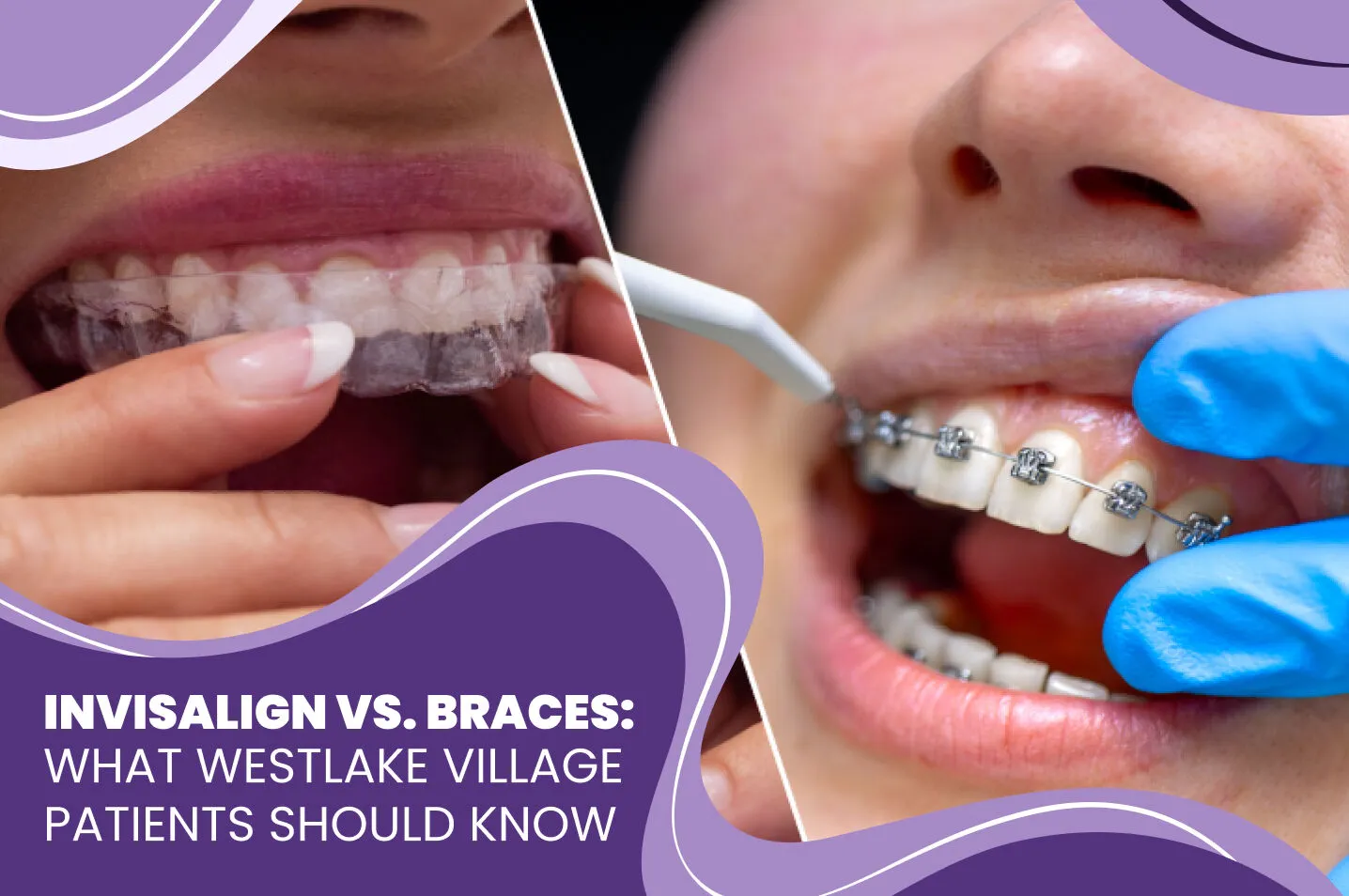
Invisalign vs. Braces: What Westlake Village Patients Should Know
09-21-2026
Patients come into our dental office on Hampshire Road with a lot of different goals. Some want whiter teeth. Some need a crown. Some are dealing with their first cavity in 20 years and are not thrilled about it. But one question comes up constantly, from teenagers and adults alike, from people who have been thinking about it for years and people who Googled it on the drive over:
Should I get Invisalign or braces?
It is a genuinely good question. Both options straighten teeth. Both are clinically proven. And both are available at our Westlake Village dental office. The difference is in the details, and the right answer depends on what your teeth actually need and how you want to live during treatment.
Here is what Dr. Hakimi and Dr. Eben actually tell patients when this question comes up.
What Invisalign and Braces Have in Common
Before we get into the differences, it helps to acknowledge what both treatments share. They both move teeth by applying gentle, consistent pressure over time. They both require regular check-ins with your dentist or orthodontist. They both have a retention phase at the end, meaning you will wear a retainer to hold your results. And when the process is complete, both can produce a beautifully aligned smile.
The question is never whether one of these options works. They both work. The question is which one works better for your specific situation and your specific life.
Where They Actually Differ
| Factor | Invisalign | Traditional Braces |
|---|---|---|
| Visibility | Clear plastic aligners, nearly invisible in conversation | Metal brackets and wires, visible from across a room |
| Removability | Fully removable for eating, drinking, brushing, and flossing | Fixed to teeth for the entire treatment period |
| Diet | No restrictions, remove aligners and eat what you want | Avoid hard, sticky, and chewy foods throughout treatment |
| Oral hygiene | Brush and floss normally; clean the aligners separately | Requires special tools; harder to clean around brackets |
| Comfort | Smooth edges, no sharp wires or brackets to irritate cheeks | Brackets can cause irritation, especially after adjustments |
| Office visits | Every 6 to 8 weeks for a brief progress check | Every 4 to 6 weeks for wire tightening and adjustments |
| Treatment length | Often 12 to 18 months for most adult cases | Typically 18 to 24 months or longer |
| Cost | Tends to be more expensive compared to braces in most cases | Tends to be more affordable compared to Invisalign in most cases |
| Works best for | Mild to moderate alignment issues; adults and teens who want discretion | Complex cases involving significant bite correction |
The Part Most Comparison Articles Skip: Candidacy
The table above makes the lifestyle comparison clear. But here is the part that matters more than any of it: whether you are actually a good candidate for Invisalign.
Invisalign technology has improved dramatically over the past decade. Today it can address crowding, spacing, overbite, underbite, crossbite, and open bite in the majority of patients who walk through our door. Most adults and teenagers with mild to moderate alignment concerns are strong Invisalign candidates.
But not everyone is. There are cases where traditional braces still do the job better. Severe jaw discrepancies, significant vertical tooth movement, and some complex bite issues respond more predictably to fixed appliances. We have seen cases where a patient came in specifically wanting Invisalign and we recommended braces instead. Not because we were steering them toward anything, but because for their particular jaw structure, braces were the more reliable path.
We will always tell you the truth about this. If braces are the better option for your case, we will say so. If Invisalign is a strong fit, we will show you exactly what it can do.
The One Thing That Changes Every Invisalign Outcome
Patients ask us all the time why Invisalign works so well for some people and seems to lag for others. The answer is almost always the same: wear time.
Aligners need to be worn 20 to 22 hours a day for the treatment to progress on schedule. Remove them for meals, for brushing, for that coffee you do not want to give up. But they go back in after. Patients who are consistent with this are consistently happy with their results. Patients who are not tend to find their treatment extending beyond the original timeline, sometimes significantly.
This is not a criticism. Life is complicated. But it is worth being honest with yourself before you start: are you the kind of person who will keep the aligners in? For most adults, the answer is yes. The low visibility and low maintenance of clear aligners actually make it easier to stay on track than the restrictions of traditional braces.
What About Invisalign for Teens?
A lot of our Westlake Village and Conejo Valley patients ask about Invisalign for their teenagers, and it is a conversation worth having. Invisalign has a specific Teen product designed for adolescent patients. It includes compliance indicators, small blue dots on each aligner that fade with wear so parents and doctors can see whether they are actually being used. It also includes replacement aligners for the ones that inevitably get left in a napkin at a restaurant.
Teen Invisalign works well for most of the same cases as the adult version. The key questions are whether the teen's permanent teeth have come in sufficiently and whether they are motivated enough to wear the aligners consistently. We talk through both of those at the consultation.
How We Approach This Conversation at Westlake Smile Design
When a patient comes in asking about Invisalign or braces, we do not start with a pitch. We start with a look. We examine the teeth, the bite, and the overall alignment picture. Then we talk through what we see, explain what each option could realistically do, and show you the digital preview of your Invisalign results if it looks like a good fit.
The complimentary consultation exists for exactly this reason. You should not have to commit to anything before you understand what is actually possible and what the process actually involves. A lot of patients who come in undecided leave with a clear sense of direction. Some choose Invisalign. Some choose braces. A few decide neither is right for them right now, and we respect that too.
What we want is for you to make the decision that is right for your teeth and your life, not for someone else's case.
Ready to Find Out Which Option Fits Your Situation?
The first appointment is always free, and there is no obligation involved. Dr. Hakimi or Dr. Eben will take a look, answer every question you have, and give you a clear picture of your options. Most patients leave knowing exactly what they want to do.
Give us a call at (805) 497-9585 or schedule online at /appointment-request. We are currently welcoming new patients from Westlake Village, Thousand Oaks, Agoura Hills, Calabasas, and across the Conejo Valley.